Apply for Partnership

Growth Beyond Sales: More Sales Won’t Save a Stalling Brand. Here’s What Actually Will.
-
 August 17, 2026
Most brands think growth comes from selling more products. In reality, growth usually comes from removing the obstacles preventing you from selling more in the first place. Many businesses don’t have a demand problem. They have an execution problem, and the two get confused constantly because they look identical from the outside: flat revenue, a plateaued growth chart, a brand that feels stuck.
The brands that grow the fastest aren’t always the ones with the best products. They’re the ones with the systems, resources, and operational support to actually capitalize on the opportunity already in front of them.
Growth isn’t just about demand
Demand generation gets most of the attention because it’s the visible part of the business. Ads, content, promotions. But demand only converts into revenue if everything behind it can support the order.
That means inventory has to be available when the customer wants to buy, not three weeks later. Product visibility has to survive the algorithm, not just the ad budget. Marketplace listings have to convert traffic instead of leaking it. Advertising spend has to be efficient enough that growth doesn’t cost more than it earns. Operations have to run consistently enough that a spike in demand doesn’t break fulfillment. Customer experience has to hold up under volume. Supply chain has to be ready before the order, not scrambling after it.
Growth is rarely limited by one factor. It’s the result of a dozen smaller systems working together, and a brand only grows as fast as the weakest one of them allows.
The hidden bottlenecks that slow growth
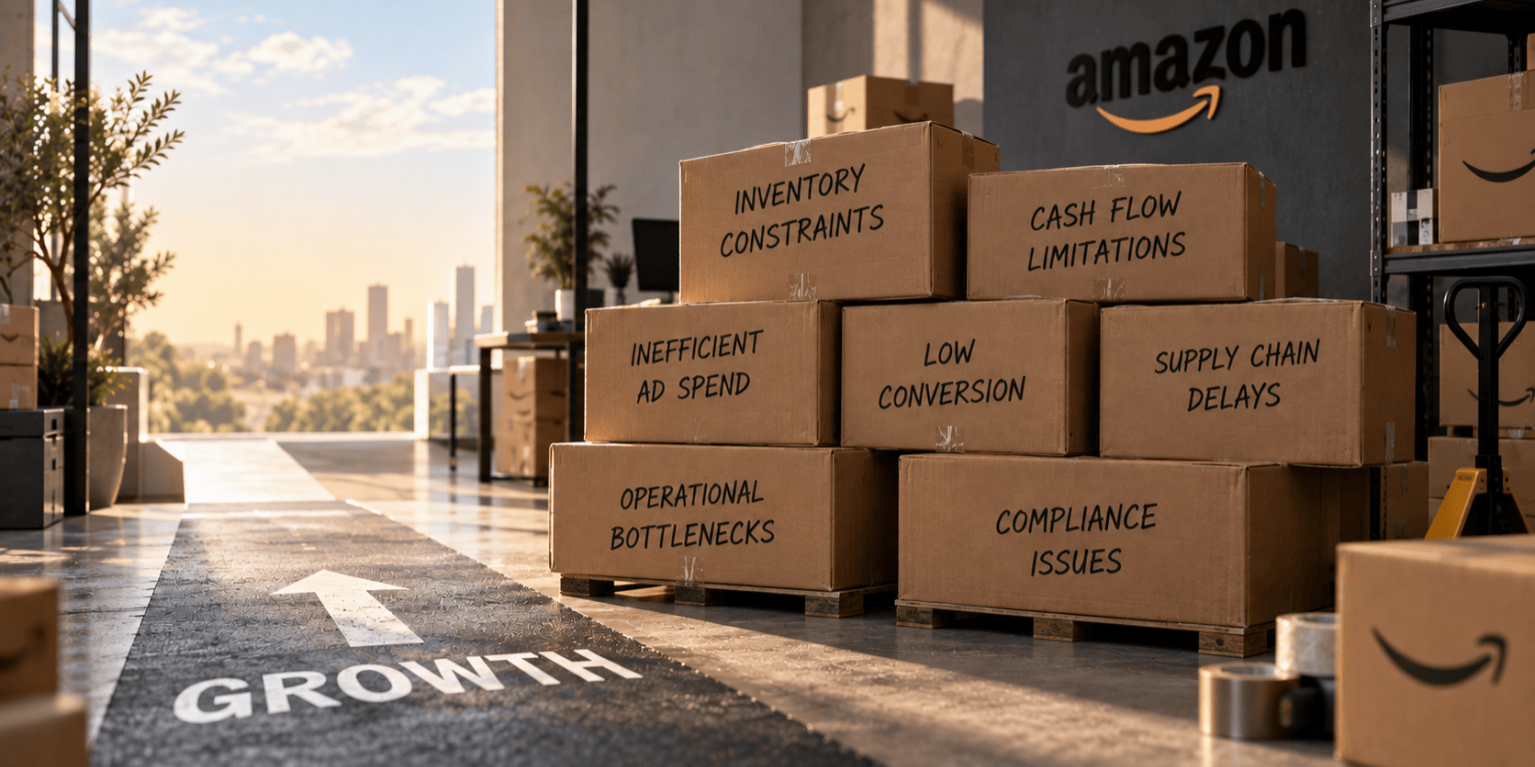
Most growth ceilings aren’t caused by demand disappearing. They’re caused by infrastructure that can’t keep pace with the demand that’s already there.
Running out of inventory during a demand spike is the most visible version of this, and it’s more common than most brands assume. Industry research puts global retail inventory distortion, the combined cost of stockouts and overstocks, at roughly $1.7 trillion a year, with about two-thirds of that tied directly to lost sales from stockouts. For mid-market ecommerce brands specifically, the average annual cost of stockouts runs into six figures once lost sales and the cost of reacquiring churned customers are both counted. And the customers lost to a stockout don’t just wait around. Close to 40% of shoppers who hit an out-of-stock product buy from a competitor instead, and that sale is gone for good, not just delayed.
Cash flow is the quieter version of the same problem. A brand can see a demand spike coming and still be unable to buy enough inventory to meet it. Cash flow has become small businesses’ top operating concern, ahead of inflation, and growth itself is often the cause: more inventory, more payroll, and more operating costs all hit before the additional revenue from that growth gets collected. A brand doesn’t need to be struggling to feel this squeeze. It’s often the businesses growing fastest that run into it first, because growth consumes cash before it returns it.
Beyond inventory and capital, the other bottlenecks tend to be operational: inefficient ad spend that keeps CAC rising faster than revenue, listings that get traffic but don’t convert it, operational capacity that was fine at last year’s volume and isn’t anymore, and the constant difficulty of keeping pace with marketplace rule changes that can quietly throttle visibility overnight.
What growth acceleration really looks like
Brands that scale well don’t wait for the bottleneck to show up before addressing it. They build the buffer in advance.
That looks like investing in inventory ahead of a demand peak instead of reacting to it after the shelf goes empty. It looks like optimizing listings specifically to improve conversion rate, not just to attract more clicks that don’t turn into sales. It looks like backing advertising strategy with the operational readiness to fulfill whatever that advertising generates, so a successful campaign doesn’t create a stockout. It looks like forecasting inventory needs against real demand signals instead of guessing. It looks like treating product availability as a growth lever in its own right, not just a supply chain metric. And it looks like monitoring marketplace performance continuously, catching the early signs of a problem before it becomes a lost sales week.
None of this is about growing as fast as possible in a single quarter. It’s about building growth that holds up the following quarter, and the one after that.
Growth happens when execution meets opportunity
Opportunity alone doesn’t move revenue. A brand can have real demand, a strong product, and a clear market opening, and still fail to capture it without the infrastructure to execute.
That infrastructure includes capital to invest in inventory before the sales, not after. Marketplace expertise to keep listings compliant and competitive as platform rules shift. Advertising support that spends efficiently instead of just spending more. Operational execution that can absorb a demand spike without breaking. Inventory planning built on real forecasting instead of guesswork. Ongoing performance monitoring that catches problems while they’re still small. And the strategic judgment to make long-term decisions instead of chasing short-term spikes.
These aren’t separate initiatives running in parallel. They’re the conditions that let a brand actually capitalize when demand shows up, instead of watching the opportunity pass while the operational pieces catch up.
How Royal Flagship helps
At Royal Flagship, we work alongside brands to remove the operational and financial barriers that often limit growth. From investing in inventory and optimizing marketplace performance to supporting advertising and day-to-day execution, our team focuses on creating the conditions that allow brands to scale with confidence.
Sustainable growth isn’t created by a single campaign or a lucky moment. It’s built through consistent execution, smart investment, and the infrastructure to support long-term success.